The lovers’ destruction of Maoist images
Serve the People!The lovers’ destruction of Maoist images is the point at which Liu Lian and Wu Dawang make their forbidden attachment material: one by one, they deface the symbols of revolutionary authority surrounding them. Their destruction becomes a contest of devotion and defiance, but it does not end in simple rejection. Wu rescues the “Serve the People!” sign from the wreckage, preserving the object that has accompanied their affair and exposing the entanglement of political language, personal memory, and love.
From a declaration of love to a test
The destruction follows a moment of unusual emotional candor. After gazing at each other through tears, Liu Lian and Wu Dawang recognize that their passion has awakened a capacity for love neither had known in themselves, while also recognizing that the relationship can end only in painful separation. Wu kneels before Liu Lian, resting his head on her lap; she kisses him and asks whether he would marry her. He answers yes, but she immediately distinguishes desire from possibility: she would marry him too, but it is impossible. Their exchange gives the scene its stakes. The lovers can affirm their attachment, but cannot make it into an ordinary future together.
Wu then tries to prove his devotion by pointing to the danger he has incurred: Liu Lian could report that he destroyed a statue, an act for which he might be shot or imprisoned for life. This appeal does not settle the question of whether she believes his love. Instead, Liu Lian turns the proof into a reciprocal test. She deliberately tears down and stamps on a portrait of Mao Zedong, telling Wu that he destroyed an image accidentally while she has done so on purpose. The distinction matters: she makes her own political transgression more deliberate, and therefore more dangerous, than his earlier act.
A contest of deliberate desecration
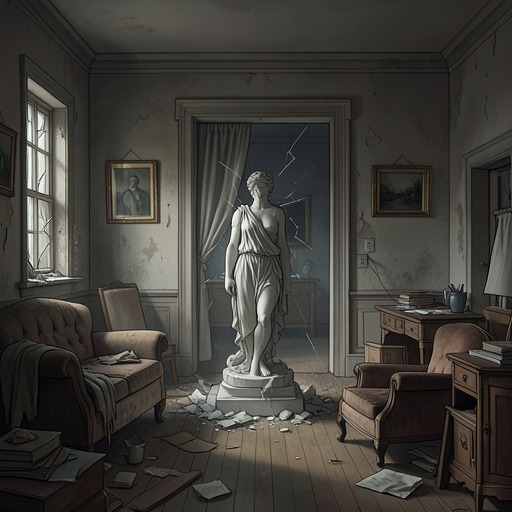
Wu responds by destroying a quotation displayed near the basin. Liu Lian takes a copy of The Selected Works of Mao Zedong, removes its jacket, tears through its pages, and stamps on the title-page portrait. The contest spreads beyond one object or gesture: Wu carries a framed double portrait of Lin Biao and Mao Zedong to the stairwell, breaks its glass, and gouges out both figures’ eyes. Liu Lian brings out an almost life-sized, gold-plated bust of Mao Zedong and chisels off its nose. Wu hammers a nail through the nose of a Mao badge, and Liu Lian drives nails through the eyes printed on a medicine cabinet.
The actions turn ordinary household and military furnishings into a catalogue of political images. Liu Lian smears Mao quotations and portraits on two enamel army mugs with ink, then throws the mugs into the ceramic basin she uses as a bidet. Over a quotation on a washbowl, Wu writes “Please Yourself.” The small alteration converts a prescribed slogan into a private counterstatement, while the mugs, cabinet, badge, framed portrait, and statue show how thoroughly revolutionary imagery has entered the objects of daily life.
Their destruction becomes systematic. They search for every item connected to Mao Zedong and the revolutionary leaders, defacing or breaking pictures, bowls, vessels, cabinets, and chairs. Liu Lian smashes the Mao-decorated rice bowls in the kitchen, and Wu breaks a new aluminium pot covered in the Chairman’s quotations. The movement through the rooms gives the act a collective, almost procedural form: each finds another emblem, and each new act invites the other to answer it. Political symbolism is not merely discussed or renounced; it is physically removed from the rooms around them.
The sign they choose to spare
The scene’s decisive reversal comes when Liu Lian reaches for the “Serve the People!” sign in the dining room. It has borne near-constant witness to their affair, and she is about to smash it along with the other Maoist objects. Wu stops her, takes it from her, and carefully puts it back on the table. When she asks why he wants to keep it, he can offer no explanation beyond saying that he simply does. His refusal marks a limit to their destruction: the sign is politically charged, but it has also acquired a personal history that makes it unlike the other objects.
Wu turns the preserved sign into the final stake in their contest. He requires Liu Lian to acknowledge that she is the greater counterrevolutionary and that she loves him more than he loves her; he threatens to smash the sign if she will not. She agrees, and he repeats the declaration three times, escalating the comparison from a hundredfold to a thousandfold and then ten thousandfold. The exchange binds a ritual of political denunciation to a game of romantic affirmation. Unlike the broken images, the sign survives because Wu makes it the witness and bargaining token of their relationship.
Political language and the private act
The scene draws force from the gulf between revolutionary language as doctrine and its practical use in the couple’s lives. The Political Instructor has insisted that the army’s work serves national and international stakes, connecting the care of Liu Lian to the Division Commander’s ability to attend meetings, the division’s battle readiness, and even the imagined possibility of world war. That argument makes intimate service an extension of duty to the People. Here, by contrast, the lovers turn political denunciation into a way to measure personal loyalty: each becomes, in the other’s playful contest, the more thoroughly condemned counterrevolutionary.
The contrast reaches beyond the couple’s private room. Soldiers elsewhere in the barracks practise political drills and educational activities under the summer sky, while official discourse continues to present exemplary service as proof of revolutionary virtue. Later, at Wu’s farewell, the institution publicly praises his study of Mao’s works and presents him as an exemplary servant of the People, although the announcement surprises him and the officers who arranged his departure. Against that polished account of service, the lovers’ destruction exposes how official slogans and portraits can coexist with private desire, fear, and self-interest. The sign’s survival prevents the episode from ending as a clean rejection: Wu destroys or permits the destruction of many emblems, but keeps the motto that has become inseparable from his affair with Liu Lian.